Quipu: when knots tell a story
How much can you say with a piece of string and a few knots? Perhaps more than we might expect today.
Long before people began storing information in computers, spreadsheets, and databases, a remarkable way of recording information existed in the Andes. It was called quipu, or khipu—a word from Quechua that simply means “knot.”
At first glance, a quipu might look like a tangle of colorful strings. In fact, it was an ingenious system that helped administer the vast Inca Empire.
And there’s something beautiful about that: information wasn’t written on paper. It was tied in knots.
꧁༺ ✦ ༻꧂
What exactly was a quipu?
A quipu consisted of a main cord with other cords hanging from it. These could vary in length, color, and texture, and different kinds of knots were tied in them.

Their arrangement was not random.
A knot’s position on a cord could indicate a particular numerical value, and the system was based on the decimal system. The color, type of cord, direction of twist, and arrangement of knots helped distinguish different categories of recorded information. NIST – Standardizing an Empire

A quipu was not just “a few strings with knots.” It was a sophisticated information system.
Skip here 🔽 if you don’t want all the details 😂
꧁༺ ✦ ༻꧂
Quipu was not invented by the Incas themselves.
It’s important to start with a common misconception.
Quipu did not originate with the Inca Empire.
The Incas adopted and greatly developed this system, but the use of knotted records in the Andes goes back further. Archaeological finds point to the use of knotted records by pre-Inca societies. For example, the Wari culture, which existed several centuries before the height of the Inca Empire, used systems based on knotted cords.
The Inca Empire itself developed primarily in the 15th and early 16th centuries. Its peak is generally placed roughly between 1438 and 1532.
So it is more accurate to say that the Incas refined quipu and used it as an important tool of government than to say they invented it.
What was quipu used for?
What we can say with the greatest confidence mainly concerns numerical and administrative records.
Quipu was used, for example, to keep records of:
population
labor obligations
tributes and taxes
supplies
agricultural production
economic data
other information needed to administer a large state
Research shows that the numerical system of quipu was based on a decimal positional system. In other words, a number’s meaning also depended on where the knot was located on the cord.
This is one of the best-documented aspects of the system.
How were numbers recorded using knots?
Researchers have found that different types of knots and their positions made it possible to record individual numerical values.
In the decimal system, position corresponded to different place values—for example, ones, tens, hundreds, and higher values.
The knot itself was not the only important factor. Its meaning could also be related to:
its type
its position
the color of the cord
the direction of the twist
the arrangement of the cords in relation to one another
It was the combination of these features that made quipu a far more complex system than it might appear at first glance.
One of the largest known systems
Some quipu were truly extensive. One example cited in academic literature is a specimen from northern Chile with 1,404 pendant cords.
That was certainly more than a simple “knot record.”
It was a structured information system capable of storing a large amount of numerical data.
Who made and read quipu?
In Inca society, there were specialists known as khipukamayuq—experts in creating and interpreting quipu.
Their job was to work with information needed to administer the empire. Historical sources and modern research point to their importance in keeping records of the population, tributes, and other administrative data.
Here’s an important detail: quipu was not something that anyone could simply “read” by following a few universal rules.
Knowledge of the system was specialized.
And this knowledge was largely passed on orally and through hands-on instruction.
Was quipu a form of writing?
This is where we need to be very careful.
Sometimes you may come across the claim online:
“Quipu was the Incas’ writing system.”
It’s not that simple.
The pre-Columbian Inca Empire had no known writing system that recorded language using symbols, as Egyptian hieroglyphs or the Latin alphabet did, for example.
However, quipu clearly served as a system for recording information, especially numerical and administrative data.
Whether some quipu could also record more complex non-numerical information—such as genealogies, historical events, or other narratives—remains a subject of scholarly research.
Some colonial sources describe such uses, and there are quipu whose structure differs from purely numerical records. However, we still have no way to reliably read these “word-based” quipu.
So the scientifically accurate thing to say is:
The numerical system of quipu has been largely deciphered. Its possible non-numerical or narrative system has not.
Quipu and the Spanish conquest
The situation changed dramatically after the Spanish arrived.
The Spanish colonial administration gradually began replacing Indigenous systems with European written records. Even so, quipu continued to be used for some time, including as a source of information for the colonial administration.
Archaeological finds also show that quipu was not solely an “Inca thing.” Some examples date from before the Incas and others from after their fall.
For example, a collection of 32 quipu discovered in Leymebamba, Peru, comes from a context spanning the pre-Inca Chachapoya culture, the period of Inca rule, and the early colonial period.
How did we begin to understand quipu?
Modern scientific study of quipu developed gradually.
An important step forward came from research by American historian of mathematics Leslie L. Locke. In a paper published in the early 20th century, he showed that the knots on quipu corresponded to numerical values arranged according to a positional principle.
His research laid the foundations for later study of quipu’s numerical structure.
Since then, researchers have studied quipu not only as historical artifacts, but also using mathematics, statistics, databases, and, more recently, methods from the mathematical theory of knots.
Research in this field continues today.
Quipu is more than a collection of knots
And this is where we get to the most fascinating part.
Quipu shows that information does not have to be recorded only in ink on paper.
It can be encoded in a material.
In a position.
In a structure.
In repetition.
And in knots.
To the Incas, a cord was not just a cord. In a particular context, it became a carrier of structured information.
And perhaps that is precisely why quipu continues to fascinate people who work with textiles and knotting techniques.
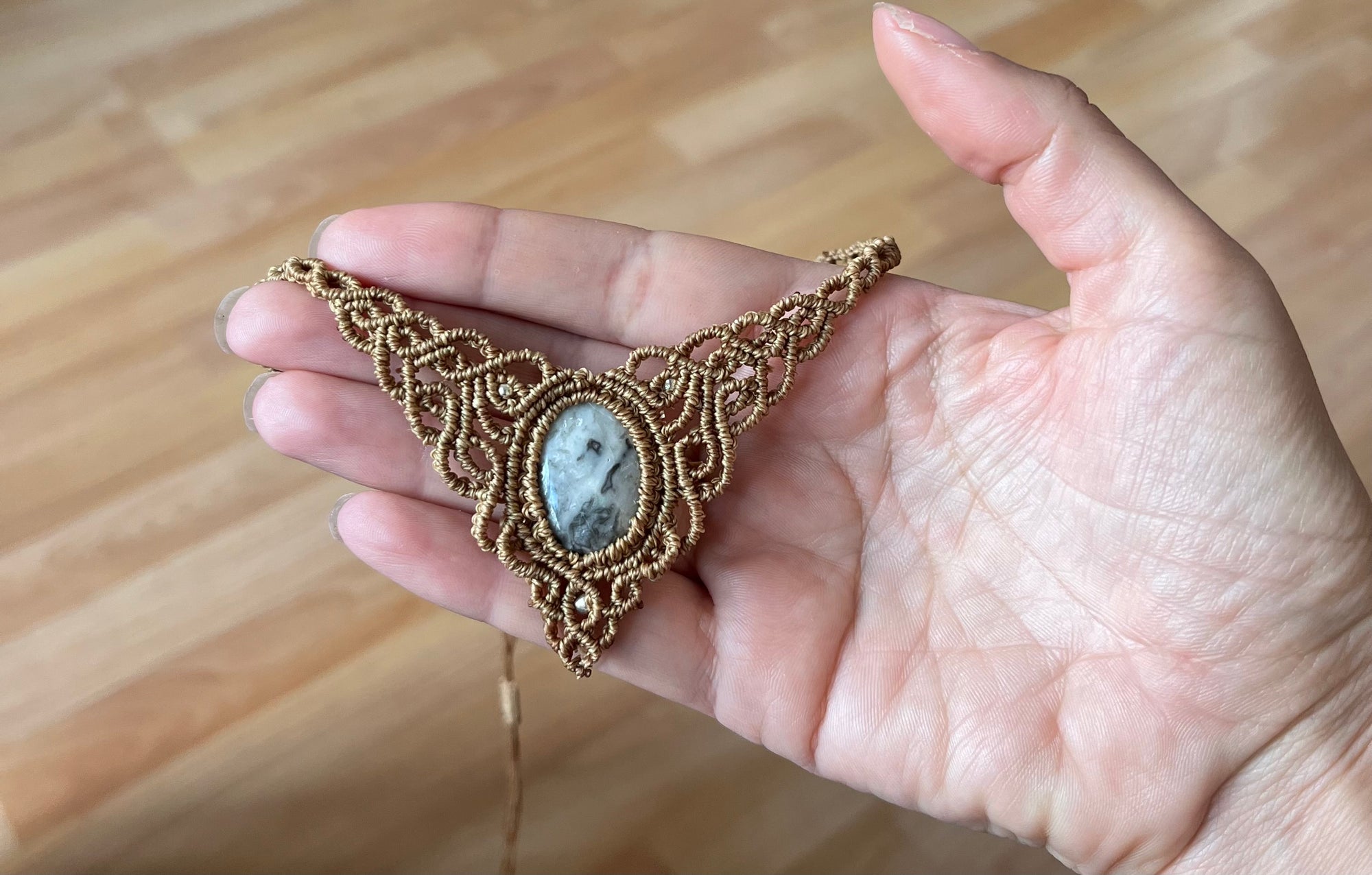
Quipu and modern macramé
But it’s important to maintain a historical distinction between the two.
Modern macramé is not a continuation of Inca quipu.
Quipu was primarily an information and administrative system, whereas contemporary macramé uses knots mainly to create decorative and functional objects.
Even so, they share one fascinating element:
THE KNOT.
With quipu, a knot could be part of a system that carried information.
In macramé, a knot is part of the structure from which a piece of jewelry, a decoration, or another object is made.
In both cases, though, a simple cord can take on an entirely new meaning through the way it is arranged.
What do we really know about quipu?
PROVEN:
• quipu was used in the Andes both before and during the Inca period
• the Incas used it as an important tool of government
• quipu could record numerical data
• its numerical system was based on a decimal positional system
• the type and position of knots, as well as the structure of the cords, mattered
• specialized experts known as khipukamayuq existed
• hundreds of historical examples have survived
STILL NOT DEFINITIVELY RESOLVED:
• whether and how quipu could be used to record a complete language
• exactly how a possible non-numerical or narrative system worked
• whether a specific historical story can be reliably “read” from a surviving quipu today
And it is this boundary between what we can already read and what remains a mystery that makes quipu one of the most fascinating information systems of the pre-Columbian Andes.
We can already read some of the knots. But the story of the system as a whole is still waiting to be discovered.
Skip here 🔽
if you don’t want all the details 😂
꧁༺ ✦ ༻꧂
Quipu in a nutshell
What did the Incas use it for?
The best-documented use of quipu was for counting and administering the empire. Quipu could be used to record things such as population, supplies, labor obligations, agricultural production, and the tribute that different regions paid to the state. Smithsonian Institution – Quipu
Imagine a vast empire stretching across thousands of kilometers of the Andes. Without modern maps, computers, or the internet, there was a need for some way to store and communicate huge amounts of information.
Quipu played an important role in this.
Specialists known as quipukamayuq were responsible for making, storing, and interpreting them. Some quipu were also carried by messengers between different parts of the empire. NIST – Standardizing an Empire
Numbers hidden in knots
One of quipu’s most remarkable features is the way it handles numbers. The Incas used a decimal system, and groups of knots were placed at different heights along a cord to represent different place values—for example, ones, tens, hundreds, and higher values. NIST – Standardizing an Empire
In other words:
A small knot did not necessarily mean the same thing as an identical knot in a different place on the cord.
Meaning emerged from a combination of several elements.
And that is exactly why quipu is so fascinating even today. It was not just a knot. It was the relationship between the knot, its position, the cord, and the entire structure.
And what about the colors?
Colors were not merely decorative either. Surviving quipu use different colors and combinations of colors. These may have helped identify categories of information or particular types of recorded data. Smithsonian Institution – Quipu
However, we cannot reliably determine the exact meaning of all the color systems today. And this brings us to one of quipu’s greatest mysteries.
Could quipu tell stories?
That question has not been definitively resolved to this day. It is fairly well established that quipu could record numerical information. However, for some other possible uses, researchers are still trying to determine whether quipu could also have functioned as a system for preserving more complex linguistic, historical, or genealogical information. British Museum – Quipu
Historical sources suggest that quipu may also have been used in connection with history, stories, or genealogies, but the way such information might have been encoded has not yet been fully deciphered. Cambridge University Press – research on khipu
So if you come across the claim that “the Incas wrote entire stories using knots,” it’s worth being cautious.
It is a fascinating possibility, not a definitively confirmed fact.
Why am I so fascinated by quipu?
Because it reminds us of something that is easy to forget in today’s digital age.
A knot can carry meaning.
Today we have text, photographs, emojis, QR codes, and databases. We store information on devices we often can’t even see. Quipu was tangible.
You could hold the information in your hands.
You could touch the cord, run your fingers over the knots, and “read” the information from it according to a particular system.
And perhaps that is exactly why this ancient system resonates with me as a macramé artist.
From quipu to macramé
Macramé is also based on knots. Each knot is made by hand. One follows another, and together they create a structure, an ornament, or an entire image.

Of course, we should not claim that today’s macramé is a continuation of Inca quipu. Historically, they are distinct traditions with different purposes.
But the idea of a knot as a basic building block is beautifully shared.
A knot can connect. It can hold things together. It can decorate. And it can also be a symbol.
Every knot can have its own story
That is the idea that inspires me most about quipu.
Imagine a piece of jewelry where a knot is not just a technical detail. It is part of a story.
A story about the journey we have taken.
About someone we love.
About a place that has left its mark on us.
About finding the courage to start again.
About our connection with nature.
Or simply about the joy of having something made slowly, by hand, and with care.
Perhaps that is exactly why handmade knotted jewelry has such a special charm.
It is never perfectly identical. Each piece is made by hand. And every knot is part of a process that can never be repeated in exactly the same way.
Quipu as inspiration for modern art
Quipu shows us that a cord does not have to be just a material.
It can carry information.
It can be a memory.
It can be a symbol.
And that is where I see a beautiful connection with macramé.
When I pick up a cord and begin knotting, I’m not just making a decoration. Gradually, something takes shape that can hold meaning for a particular person.
Maybe it’s an amulet.
Maybe it’s a piece of jewelry.
Maybe it’s a gift.
Or maybe it’s simply a small reminder that some things are more valuable precisely because they are made slowly.
So next time you tie a knot, try asking yourself:
What if every knot told its own story?
Because that is one of the most beautiful ideas that ancient quipu can remind us of.
꧁༺ ✦ ༻꧂
Note: Quipu is a historical system for recording information associated primarily with Inca culture. Its numerical system is now relatively well understood, while the question of whether and how some quipu recorded more complex non-numerical information remains a subject of research. Smithsonian Institution – Quipu